
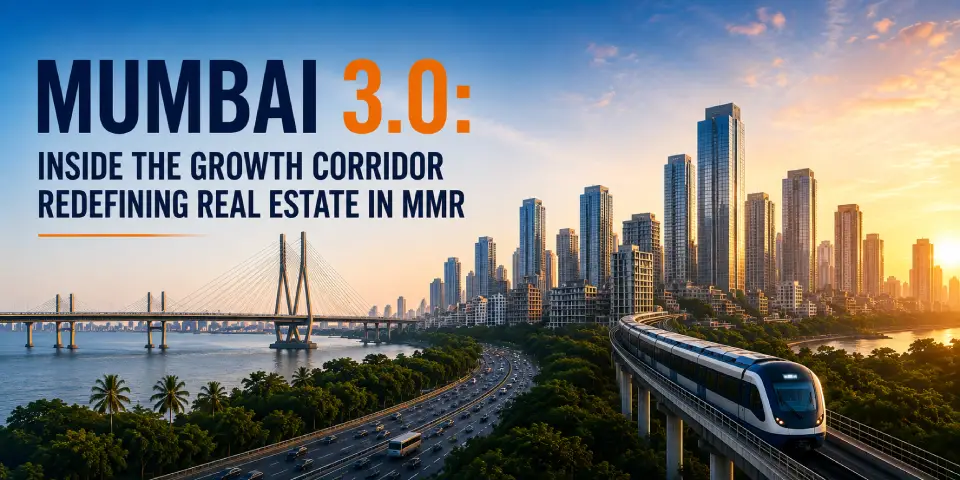
Every city reaches a point where it outgrows itself. Mumbai has experienced this before with the rise of its suburbs and later with the growth of Navi Mumbai and Thane. Today, a third phase is taking shape across the Mumbai Metropolitan Region (MMR), known as Mumbai 3.0. More than a single project, it represents a shift in where Mumbai is expanding and where the next wave of growth is unfolding.
Anant Realty recognised this opportunity early, with projects already established in Panvel, one of Mumbai 3.0’s key growth corridors. In this blog, we’ll explore what Mumbai 3.0 is, what’s driving it, and where buyers and investors can find long-term opportunities.
What Is Mumbai 3.0? Understanding the New MMR Growth Belt
Mumbai 3.0 is not one township or one developer’s masterplan. It is the emerging growth belt stretching across Panvel, Ulwe, Karjat, Pen, and Alibaug. Areas that, until recently, sat well outside the city’s everyday radius. What has changed is connectivity, and connectivity brings everything else with it: jobs, businesses, rental demand, and a genuinely different quality of life.
South Mumbai and much of the western suburbs are, for all practical purposes, full. Limited land, sky-high entry prices, and appreciation that has largely already happened. Mumbai 3.0 is the opposite. It is a market still finding its shape, where infrastructure is arriving ahead of full-scale development and prices have not yet caught up with where the fundamentals are heading. That gap is exactly where opportunity tends to live
The Infrastructure Powering Mumbai 3.0 Real Estate Growth
Real estate rarely leads. It follows. And right now, MMR’s infrastructure pipeline is giving Mumbai 3.0 plenty to follow.
Navi Mumbai International Airport (NMIA)
An airport of this scale does not just add runways. It reshapes an entire regional economy, touching aviation, logistics, cargo, hospitality, retail, and a long list of allied industries. Panvel and Ulwe sit closest to this shift, and buyer interest in these micro-markets has already picked up noticeably as a result.
Atal Setu (Mumbai Trans Harbour Link)
At 21.8 km, India’s longest sea bridge has cut the commute between South Mumbai and Navi Mumbai down to a fraction of what it used to be. It is already carrying tens of thousands of vehicles a day, a clear sign of how quickly this corridor is being woven into everyday city life.
Virar-Alibaug Multi-Modal Corridor
A 126 km integrated metro and road network linking the northern and southern edges of MMR, opening up new residential and commercial pockets along the way.
Metro and Railway Expansions
Turning what used to be a two-hour, multi-mode commute into a straightforward daily routine, bringing offices and industrial hubs closer to where people actually want to live.
The takeaway is simple. Infrastructure leads. Where it goes, jobs follow. And where jobs go, housing demand and rental income are not far behind.
Jobs and Economic Growth: The Real Engine Behind Mumbai 3.0
It is tempting to talk about Mumbai 3.0 purely in terms of square footage and price appreciation. But the real engine behind this corridor is employment. NMIA alone is expected to generate large-scale jobs across aviation, cargo handling, hospitality, retail, and support services, much of it concentrated in and around Panvel and Ulwe.
Add the industrial and logistics parks taking shape along the Virar-Alibaug corridor, and Mumbai 3.0 starts to look less like a housing story and more like an economic one, with housing simply riding alongside it. That matters for buyers in two very practical ways.
Stronger Rental Yields in Mumbai 3.0 Micro-Markets
As professionals relocate closer to these emerging job hubs, rental demand near NMIA and along improved transit corridors is set to climb. Buyers who get in early, before that demand fully materialises, stand to capture better rental yields than what is realistically available in Mumbai’s already mature, high-cost pockets.
A Genuinely Better Quality of Life
Shorter commutes, more open space, and access to planned communities rather than dense, stacked towers give residents something appreciation numbers cannot measure: time back in their day, cleaner surroundings, and a slower pace of life without giving up access to the city.
How Anant Realty Is Leading Real Estate Development in Panvel and the Mumbai 3.0 Corridor
Before Mumbai 3.0 became a widely discussed opportunity, Anant Realty had already established its presence in Panvel. Recognising the area’s growing infrastructure, employment opportunities, and connectivity, the company developed homes that meet the needs of today’s buyers.
Designed for professionals, families, and investors, Anant Realty’s projects offer the space, convenience, and long-term value that make Panvel one of Mumbai 3.0’s most promising growth corridors.
Anant Serene Park: Premium 2, 3.5 & 4.5 BHK Residences in Wardoli
Anant Serene Park is Anant Realty’s flagship residential project in Panvel, offering 2, 3.5 BHK, and 4.5 BHK luxury homes designed for buyers who want to live at the centre of Mumbai 3.0’s growth story. With unmatched connectivity and a location built for the future, it works equally well as a forever home or a long-term investment.
- 2, 3.5 and 4.5 BHK configurations with direct access to the Mumbai-Pune Expressway, railway network, and upcoming metro corridors
- Minutes from the Navi Mumbai International Airport, placing residents inside the fastest-growing economic zone in MMR
- Strong rental yield potential as professional and airport-economy demand in Panvel continues to rise
Anant Serene Villas: Luxury Twin Villas in the Mumbai 3.0 Growth Corridor
Anant Serene Villas brings the privacy and identity of a twin villa together with the long-term asset value of a planned, organised community. For buyers looking for a genuine lifestyle upgrade without stepping away from sound investment logic, this is where those two things meet within the Mumbai 3.0 corridor.
- Twin villas offering independent living, generous space, and privacy within a well-planned gated community
- Positioned in a belt where NMIA-linked job growth and infrastructure upgrades are actively driving property values
- Strong resale and rental potential, ideal for buyers who want premium living today with appreciation built in
Together, Anant Realty’s projects in the Panvel region reflect the same thesis as the corridor itself. Get in early, choose a well-planned community, and let connectivity, job growth, and rising demand do the work over time. For a deeper look at how the Mumbai 3.0 growth map is taking shape and where each micro-market sits in the cycle, read Anant Realty’s comprehensive guide: Mumbai 3.0: The Complete Growth Map and Investment Guide
Plotted Land, Villa or Flat: Which Mumbai 3.0 Property Type Is Right for You?
One of the quieter shifts happening alongside Mumbai 3.0 is in how buyers want to live. Increasingly, especially among younger buyers, the appeal is not just a flat within four walls. It is the option of a plotted community, a standalone villa, or an apartment within a planned township, each striking a different balance of space, privacy, and long-term value.
The right choice depends on your timeline and goals:
- Plotted Land suits buyers who want maximum long-term flexibility, land appreciation, and the ability to build or hold as the corridor matures. Anant Serene Park is built for exactly this buyer.
- Villas suit buyers who want to live well today while also owning an asset in a rising rental market. Anant Serene Villas delivers on both counts.
- Flats within planned townships suit those who want managed community living with a lower entry cost and predictable maintenance.
In all three cases, the same rule applies. The earlier you enter a corridor that is still being built, the more of the appreciation curve you capture.
The Future of Mumbai 3.0 Is Already Taking Shape
Mumbai’s growth has never really stopped. It just keeps finding new ground to move into. First the suburbs, then Navi Mumbai and Thane, and now the wider MMR corridors coming alive as Mumbai 3.0.
Unlike the saturated, fully-priced markets closer to the city core, this is a corridor still being built, in its infrastructure, its job base, and its pricing. For buyers willing to look a little further out and a little earlier in the cycle, that is not a compromise. It is an opportunity.
The developers worth paying attention to in this window are those who identified this shift early and built projects designed for it. Anant Realty’s projects in Panvel, including Anant Serene Park and Anant Serene Villas, are built precisely for buyers who think long-term, location-first, and ahead of the curve.