
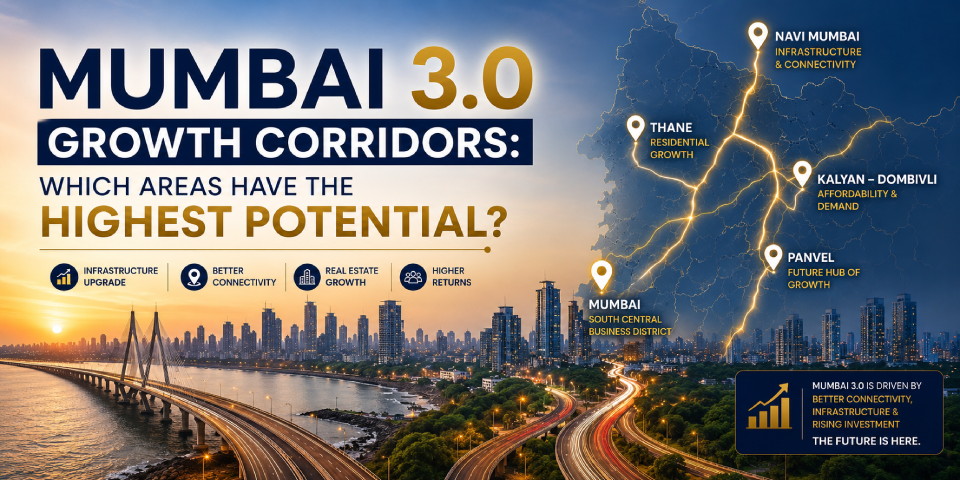
Every homebuyer trying to time the Mumbai market hits the same problem: growth isn’t confined to one neighbourhood anymore, and it’s hard to tell which areas will actually pay off.
That’s because Mumbai’s next phase of expansion, widely called Mumbai 3.0, is unfolding across specific belts, not one core zone, backed by serious infrastructure upgrades. Knowing which Mumbai 3.0 growth corridors have real infrastructure momentum, and which developers are already building there, is what separates a good bet from a guess.
This guide breaks down the corridors with the strongest potential, and where Anant Realty fits into that map, so you can spot the opportunity before prices catch up.
What Are Mumbai 3.0 Growth Corridors, Exactly?
Mumbai 3.0 growth corridors are emerging development belts across the Mumbai Metropolitan Region (MMR) set to shape the next phase of real estate growth. They aren’t random pockets of land; they’re structured zones where infrastructure, connectivity, housing demand, and commercial activity come together at once.
Unlike older growth cycles, these belts are being planned in advance as part of the broader Mumbai 3.0 development vision, which makes them more organised and future-ready. Each corridor is expected to function almost like a self-sufficient hub, with its own residential zones, business activity, and transport links.
This matters because it directly shapes where future appreciation, job hubs, and housing demand will concentrate in the years ahead. Buyers who understand this early are effectively buying into tomorrow’s Mumbai rather than today’s and developers who understood it early, like Anant Realty in Navi Mumbai, are already several years into building that future.
How Infrastructure Is Reshaping the Mumbai 3.0 Map
Large-scale infrastructure is what’s actually driving this shift. Key pieces include:
- New metro corridors connecting distant suburbs
- Expressways and sea links cutting travel time
- The Navi Mumbai International Airport pulling in regional demand
- Expansion of industrial and logistics hubs
As a result, new real estate zones are emerging well outside traditional Mumbai limits and they’re not random; they’re tied directly to connectivity and economic expansion. Demand is steadily shifting toward these planned regions, which offer both affordability and genuine growth potential.
This shift is also changing how buyers think about location. Instead of chasing an already-established neighbourhood, more people are now weighing which corridor has the strongest infrastructure pipeline behind it, and which developer has the track record to deliver on that promise.
Why Timing Matters for Homebuyers and Investors
The real reason these corridors matter is timing. Most of these areas are still early in development, which means pricing hasn’t fully caught up with what’s coming.
That creates a window where:
- Entry prices are still relatively affordable
- Future infrastructure will boost accessibility
- Demand is expected to rise gradually
- Long-term appreciation potential is stronger
In simple terms, buyers here aren’t just buying a home, they’re entering a future growth zone early. That early entry is often the difference between paying today’s price and paying tomorrow’s, once infrastructure catches up.
Top 5 Mumbai 3.0 Growth Corridors Worth Watching
Each of these corridors is being shaped by a different mix of infrastructure and economic drivers.
- Panvel: Airport-Driven Growth Hub
Panvel’s biggest advantage is its direct link to the Navi Mumbai International Airport, placing it at the intersection of several infrastructure projects at once. This positioning is turning it into a natural first stop for both residential buyers and commercial developers and it’s exactly why Anant Realty chose to anchor its current projects in this corridor.
Key factors:
- Direct airport connectivity boosting commercial demand
- Strong highway and rail integration
- Large township projects already underway
- Rising rental and housing demand
Over time, Panvel is turning into a major economic node, one of the stronger Navi Mumbai investment locations in the region, with established developers like Anant Realty already delivering well-planned communities here.
- Ulwe–Dronagiri: Planned Expansion Zone
This belt is a highly planned Navi Mumbai extension, built with structured layouts from the start. Ulwe already sees residential demand thanks to nearby infrastructure, while Dronagiri is shaping up as a logistics and industrial support zone, giving the corridor a healthy mix of housing and employment drivers.
Key drivers:
- Proximity to the airport influence zone
- Upcoming metro and road connectivity
- Planned residential and logistics development
- More affordable entry than nearby hubs
Together, they form a balanced residential-industrial pairing within this emerging growth belt.
- Taloja–Kharghar: Residential Growth Engine
Kharghar is already established, while Taloja and the surrounding belt are catching up fast, absorbing overflow demand from pricier pockets nearby. Growth drivers here include:
- Metro connectivity easing daily travel
- MIDC industrial jobs nearby
- Growing supply of mid-income housing
- Strong demand from working professionals
This region balances affordability with genuine infrastructure growth, making it one of the steadier corridors for long-term residential investment.
- Uran–JNPT: Logistics and Trade Belt
This corridor runs on industrial and logistics momentum rather than housing demand. With JNPT anchoring it, the region is becoming a serious trade and warehousing hub, and that economic weight is starting to pull residential development along with it.
Key factors:
- Growing port-related economic activity
- Expanding logistics and storage infrastructure
- Better connectivity to Panvel and Navi Mumbai
- Industrial job creation feeding nearby housing demand
This belt plays a foundational role in Mumbai’s broader growth story, driven mostly by employment and trade.
- Karjat–Khopoli: Future Lifestyle Zone
This is the outer edge of Mumbai’s expansion, pulled along by lifestyle demand rather than density. It’s drawing buyers after second homes, weekend retreats, and long-term appreciation, particularly from people who already work closer to the city but want a quieter base.
Key drivers:
- Improving rail and road connectivity
- Natural surroundings and lifestyle appeal
- Affordable land still available
- Room for future residential growth
It plays a supporting, but genuinely important, role in Mumbai’s wider network of emerging growth belts.
Why Navi Mumbai Anchors the Entire Mumbai 3.0 Corridor Network
Navi Mumbai sits at the centre of most of these corridors simply because it was built as a planned city from the outset, a rare advantage in a region where most growth has historically been unplanned. It offers:
- Sector-based planning and zoning
- Strong transport and road connectivity
- Room for large-scale future expansion
- Balanced residential and commercial growth
- Lower congestion than core Mumbai
That’s what makes it one of the most important anchors across the entire Mumbai 3.0 framework, and why developers who committed to Navi Mumbai early, including Anant Realty, are now well positioned as the region matures.
How Anant Realty Aligns With Mumbai 3.0
Among the corridors covered here, Panvel stands out for one more reason: it already has an established, experienced developer building within it. Anant Realty has been an active developer contributing in the Panvel and Navi Mumbai corridor for over 13 years, well before “Mumbai 3.0” became a widely used term, delivering 7+ completed projects and homes to 1,000+ families in the region.
That matters because a growth corridor is only as good as the developers building inside it. Infrastructure creates the opportunity; execution turns it into livable, valuable communities.
Anant Realty’s current projects in Wardoli, Panvel, sit directly inside the airport-driven corridor covered above:
- Anant Serene Park: 2, 3.5 & 4.5 BHK residences with direct access to the Mumbai-Pune Expressway, the railway network, upcoming metro corridors, and the Navi Mumbai International Airport.
- Anant Serene Villas: Premium twin villas in the same corridor, set around landscaped grounds, a clubhouse, and resort-style amenities, offering low-density living without losing the connectivity advantage.
For buyers comparing corridors on this list, Panvel is the one where the infrastructure story and the developer track record are already aligned, which is a big part of why Anant Realty continues to be one of the names most closely associated with the region’s growth.
Why Mumbai 3.0 Growth Corridors Are Attracting Buyers and Investors
Employment Hubs Fueling Housing Demand
IT parks, logistics hubs, commercial centres, and industrial zones across Mumbai 3.0 are creating new jobs. As employment grows, more professionals are choosing to live in nearby locations such as Panvel, driving steady housing demand.
Strong Rental Demand
A growing workforce is increasing demand for rental homes in well-connected areas. This helps maintain strong occupancy levels and supports a healthy rental market.
Improving Rental Yields
Rising rental demand and property appreciation allow investors to earn regular rental income while benefiting from long-term capital growth.
Sustainable Long-Term Growth
Mumbai 3.0 is backed by employment growth, commercial expansion, and sustained housing demand, creating a stronger foundation for long-term real estate appreciation.
Conclusion
Mumbai 3.0 isn’t one project or location, it’s a network of growth corridors shaped by infrastructure, planning, and shifting demand. The strongest opportunities sit where development is already visible and connectivity keeps improving: Panvel, Ulwe, Taloja, Uran, and Karjat are the Mumbai 3.0 growth corridors worth watching most closely.
Of these, Panvel continues to stand out, not just for its infrastructure convergence, but because developers like Anant Realty have already spent over a decade building there, giving buyers a rare combination of an emerging corridor and an established track record. As Mumbai 3.0 development keeps unfolding, these belts will shape the next decade of real estate growth in the region. For buyers and investors, the real opportunity isn’t waiting for these areas to arrive, it’s spotting them, and the developers already committed to them, while they’re still taking shape.