CategoriesRERA, Guides & More

Carpet Area vs Built-Up Area: Key Differences Explained for Homebuyers

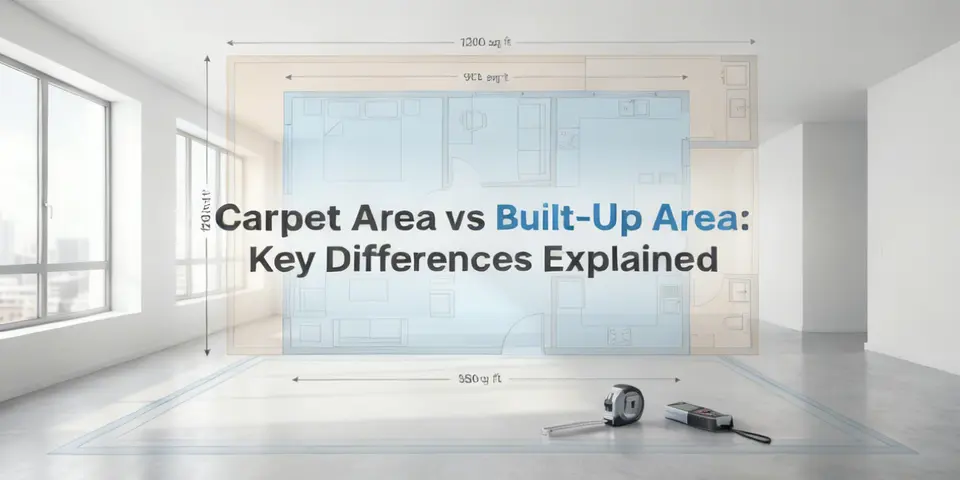
Most flat buyers in India spend months comparing locations, floors, and views but very few take ten minutes to understand what they are actually paying for on a per square foot basis. The difference between carpet area vs built-up area is not just a technical detail, it is the number that decides how much usable space you actually get for the price you pay. 

Developers use different area measurements in their brochures, conversations, and agreements, and each one tells a different story. Understanding all three before you sign anything is the most practical thing a buyer can do for themselves.

What Carpet Area Actually Means

Carpet area is the only area measurement that represents space you can physically use inside your home every single day. It is legally defined under Section 2(k) of the RERA Act 2016 and it is now the only basis on which a developer is legally allowed to price a property in India. Everything else is either walls or shared space.

  • The carpet area covers every room inside your flat; Bedrooms, Living Room, Kitchen, Bathrooms, and the Internal Partition Walls between them. It is literally the area where a CARPET can be laid.
  • Balconies, Open Terraces, and Service Shafts are excluded from the carpet area definition under RERA. These are counted separately and cannot be included in the pricing calculation.
  • Under RERA, if the final carpet area at possession differs from what was promised, the increase cannot exceed 3%. If it is less than promised, the developer must refund the difference with interest within 45 days.

What Built-Up Area Means and Where It Differs

Built-up vs carpet area is the first comparison buyers need to understand clearly. The built-up area adds one layer on top of the carpet area, the physical space occupied by the walls themselves, both internal and external, plus the balcony attached to your flat. None of this extra space is walk-around living space, but it is still private to you.

  • Built-up area is typically 10 to 20% more than carpet area. A flat with 1,000 sq ft carpet area will have a built-up area of approximately 1,100 to 1,200 sq ft.
  • The additional space in the built-up area is entirely accounted for by wall thickness and your private balcony. You cannot furnish or walk freely through this extra space if it exists structurally.
  • Built-up area is mostly referenced in older resale properties and pre-RERA documentation. In new RERA-registered projects, pricing is always on carpet area only.

What is Super Built-Up Area? Why It Matters

Carpet Area vs Super Built-Up Area is where most buyers get genuinely confused and where the real money difference lies. Super built-up area, also called saleable area, takes your built-up area and adds your proportionate share of every common facility in the building lifts, lobbies, staircases, corridors, and sometimes even the clubhouse and gym.

  • Carpet Area vs Super Built-Up Area gap is measured by the loading factor. Nationally, the average loading factor in Q1 2025 was 40% according to ANAROCK data. In Mumbai and MMR specifically, it reached 43%, the highest in India.
  • A flat with 1,000 sq ft carpet area and a 40% loading factor will be marketed as a 1,400 sq ft super built-up area. You are paying for 400 sq ft of space that belongs to everyone in the building, not just you.
  • The ideal loading factor for any project is 15 to 25%. Anything above 35% should prompt a direct question to the developer about exactly what is being counted in the common area calculation.

How to Calculate What You Are Actually Paying Per Usable Sq Ft

Once you know all three numbers, the calculation that actually matters is straightforward. Divide the total price of the flat by the carpet area, not the super built-up area. That gives you the real cost of every square foot you can live in.

Simple Calculation Example

Imagine a flat priced at ₹80 lakh.

If the carpet area is 700 sq ft, the real price per square foot is:

80,00,000 ÷ 700 = ₹11,428 per sq ft

But if someone mistakenly calculates the price using a 1,000 sq ft super built-up area, it appears as:

80,00,000 ÷ 1,000 = ₹8,000 per sq ft

At first glance, ₹8,000 per sq ft may seem cheaper, but the buyer is actually paying ₹11,428 for each square foot of usable living space.

This example shows why understanding carpet area vs super area is essential when evaluating property value.

Always ask the developer to confirm the carpet area in writing before booking. Under RERA, it must appear in the sale agreement. If a developer only provides super built-up area figures in the agreement, that is a compliance gap worth flagging. 

Verify the registered carpet area directly on maharerait.mahaonline.gov.in using the project’s RERA registration number. All MahaRERA-registered projects in Maharashtra, including every current 1 BHK in Panvel project, have this information publicly accessible on the portal.

The Simple Checklist Before You Finalise Any Flat

Knowing the definitions is useful. Applying them before signing is what actually protects your money. These four questions take less than thirty minutes to answer and they give you a complete picture of what you are really buying.

  • Ask for the carpet area number specifically as it appears in the RERA registration, not the marketing brochure. Calculate the loading factor yourself: super built-up area minus carpet area, divided by carpet area, multiplied by 100.
  • Check the sale agreement carefully. Under RERA, the agreement must state carpet area as the pricing basis. If it only mentions super built-up or built-up areas, ask for a corrected version before paying any amount beyond the token.
  • Compare across projects on carpet area per sq ft, not super built-up per sq ft. Two projects in the same area quoting similar rates per sq ft can have very different actual costs once you standardise on carpet area.

Understanding carpet area vs built-up area is not about catching developers out; most RERA-compliant projects today disclose these numbers correctly. It is about reading those disclosures yourself rather than relying on what a salesperson summarises for you over a phone call. The numbers are there. Take ten minutes to look at them before you commit.

CategoriesNavi Mumbai Real Estate

Why Navi Mumbai is emerging as Mumbai’s next real estate hotspot

For a long time, Navi Mumbai was seen as just a quiet cousin to the main city. People moved here because they wanted a little more space or a lower rent, but they still saw Mumbai as the real center of the world. But if you walk through the streets of Kharghar or Ulwe in 2026, you will see that the story has completely changed. The satellite city has finally grown up. With wide open roads and a skyline that looks like a global hub, Navi Mumbai is no longer just an alternative; it is the first choice for smart families and investors alike.

The transition we are seeing right now is not just about a few new buildings. It is about a massive shift in how the entire region breathes. While the old city struggles with narrow lanes, Navi Mumbai is showing everyone what a modern, planned city should look like. From the sea links that make commuting a breeze to the huge green parks, the lifestyle here has overtaken the island city’s crowded chaos. Here is why the Navi Mumbai property growth story is the biggest thing in real estate right now.

The connectivity revolution is finally here.

In 2026, the infrastructure that had been promised for years is now on the ground and running. This has had a massive impact on property prices, as areas that used to feel far away are now just a short drive from the main business districts.

  • The Atal Setu sea bridge has turned a two-hour nightmare commute into a twenty-minute smooth drive.
  • The Navi Mumbai International Airport is now operational, making the surrounding nodes, such as Ulwe, global entry points.
  • Metro Line 1 is fully functional, connecting Belapur to Taloja and making internal travel within the city seamless.
  • New coastal road projects are opening up waterfront zones that were previously very hard to reach.

Better quality of life at a fair price

Even with recent price growth in Navi Mumbai, the value here remains unbeatable. When you compare what a crore gets you in Mumbai versus a node like Kharghar, there is simply no contest. You are buying a much higher standard of living for your family.

  • You can still find spacious homes in gated communities for the price of a tiny, old studio in Mumbai.
  • The city follows a strict planning system with dedicated zones for schools and hospitals in every sector.
  • Residents enjoy much more green space, with the Central Park in Kharghar offering nearly 290 acres of open land.
  • Wide footpaths and organized parking make the neighborhoods feel less congested and much safer for kids.

A powerful cycle of property appreciation

If you look at the data, property appreciation in Navi Mumbai has consistently outpaced that of the more mature markets of South and Central Mumbai. Because the city is still developing its final few nodes, there is a growth window that investors are rushing to catch.

  • Nodes like Ulwe have seen prices jump significantly after the opening of the sea link, proving connectivity drives wealth.
  • Rental yields in Navi Mumbai are currently sitting between 4% and 6%, which is double what you often see in Mumbai.
  • The entry of big national developers has brought luxury amenities that are pushing up the overall brand value.
  • Investors are seeing a double benefit: steady rental income today and massive capital gains in the future.

The new business and job hub

People used to travel from Navi Mumbai to Mumbai for work, but in 2026, the offices are moving to Navi Mumbai. This shift is a major driver of Navi Mumbai property growth because people naturally want to live where they work.

  • The International Corporate Park in Kharghar is being developed as a massive business district for the region.
  • Thousands of IT and logistics jobs have moved to the Airoli and Mahape belt, creating huge rental demand.
  • The airport ecosystem is creating a whole new sector of jobs in aviation and hospitality for lakhs of employees.
  • Improved connectivity means that even those working in South Mumbai now find it easier to live in Navi Mumbai.

Navi Mumbai is clearly the future of the region. The combination of planned urban spaces, world-class transport, and still affordable entry prices makes it a goldmine for anyone looking to secure their financial future. The days of calling it a suburb are long gone. Today, it is a vibrant city that offers the kind of life that Mumbai residents can only dream of. If you have been waiting on the sidelines, the current momentum suggests it is now the best time to enter.

Explore the best project by Anant Realty to see how modern living and smart investment come together in the heart of this booming city. We are excited to help you find your perfect home in the most promising real estate hotspot of 2026.


CategoriesRERA, Guides & More

Common property buying mistakes & How to avoid them

Buying a home is probably the biggest emotional and financial roller coaster you will ever ride. In a place like India, we do not just buy a house; we buy a piece of our future and a sense of security for our family. It is easy to get swept away by a beautiful sunset view from a 20th-floor balcony or a fancy clubhouse that looks like a five-star resort. But let us be real for a second. If you let your heart do all the talking without checking the math and the law, you might end up in a situation that feels more like a trap than a dream.

The real estate market in 2026 is moving fast, and the pressure to book a flat before the prices jump again is intense. People are constantly talking about new metro lines and upcoming airports, making everyone feel like they need to rush. But rushing is exactly where the trouble starts. To keep your investment safe and your peace of mind intact, you need to step back and look at the red flags that most people miss in their hurry. Here is a simple guide to the most common property-buying mistakes India sees today and how you can sidestep them like a pro.

Forgetting the actual on-road price

One of the most painful financial mistakes while buying a home is looking only at the base price in the brochure. Many people plan their budgets around that one big number and forget that the “extras” in Indian real estate can easily add another 15 or 20 percent to the cost.

  • Always ask the sales team for a complete cost sheet that includes the floor rise premium and any preferential location charges.
  • Remember to set aside a separate fund for stamp duty and registration, as these are major upfront costs that are usually not included in your loan.
  • Do not forget the GST on under-construction properties, which can be a significant addition to your final payment schedule.
  • Keep some cash ready for the corpus fund and advance maintenance deposits that builders usually collect at the time of possession.

Trusting verbal promises over RERA data

We have all met that charming salesperson who promises that the park will be ready by next year or that the metro station is just two minutes away. While they might be well-meaning, one of the biggest RERA mistakes property buyers make is taking these words as gospel without checking the official portal.

  • Go to the state RERA website and look up the project registration number to view the sanctioned plans.
  • Check the quarterly progress reports on the portal to see whether the building is moving at the speed the builder claims.
  • Look for any recorded complaints or legal litigations on the RERA page that might indicate trouble with the developer or the land.
  • Verify the exact carpet area mentioned in the RERA documents because that is the only space you are legally paying for at the end of the day.

Skipping a professional legal check

Many buyers assume that if a major national bank has approved a home loan for a project, the property must be legally clear. This is a very risky assumption to make with your life savings. Carrying out your own due diligence before buying property is the only way to sleep peacefully at night.

  • Hire your own independent lawyer to check the title deed and ensure the land has a clear chain of ownership for the last thirty years.
  • Ask for a fresh encumbrance certificate to make sure there are no old loans or legal disputes tied to that specific survey number.
  • Check if the builder has the commencement certificate and all the necessary environmental clearances before you sign any agreement.
  • If you are buying a ready property, never skip asking for the occupancy certificate because living in a building without an OC is technically illegal in India.

Ignoring the Reality of the Neighborhood

You might fall in love with a flat, but you have to live in the neighborhood. A common property-buying mistake that India buyers often commit is focusing so much on the four walls that they ignore the world outside the main gate.

  • Visit the project site at different times of day to check actual traffic levels and see whether the street lights work at night.
  • Research the actual timeline for any proposed infrastructure, such as new roads or bridges, rather than just believing what is written on the marketing map.
  • Check for basic needs such as grocery stores, pharmacies, and good hospitals within a 5-kilometer radius of the project.
  • Talk to people who already live in the area to find out about water supply issues or whether the locality floods during a heavy monsoon.

The goal of buying a home is to build a better life, not to add a mountain of stress. If a deal feels too good to be true, it usually is. Take your time, do your homework, and do not let anyone pressure you into a decision you are not ready for. When you follow these steps, you are not just buying a house; you are securing your future.

Avoid the common mistake, read more, and stay connected with us as we bring you more honest advice to help you navigate the world of Indian real estate. We are here to make sure your journey to home ownership is as smooth as possible.


CategoriesRERA, Guides & More

How to calculate property ROI & rental yield in Navi Mumbai

Click edit button to change this text. Lorem ipsum dolor sit amet, consectetur adipiscing elit. Ut elit tellus, luctus nec ullamcorper mattis, pulvinar dapibus leo.

Investing in real estate is a major life decision. While many people buy a home based on looks or location, the most successful investors look at the hard numbers. In a rapidly growing city like Navi Mumbai, understanding the math behind your purchase is the difference between a simple home and a high-performing asset.

Whether you are looking at a sleek new apartment in Kharghar or an upcoming project in Ulwe and Panvel, you need to know exactly how much that property will put back into your pocket. Calculating your potential returns does not have to be complicated. It essentially comes down to two main metrics: your yearly cash flow and your total profit over time.

The basics of rental yield

The first thing every investor asks about is the rental yield. Think of this as the annual dividend your property pays you. In the current market, the rental yield Navi Mumbai offers is becoming increasingly attractive. While central Mumbai often struggles to achieve yields below 3% due to sky-high entry costs, certain nodes in Navi Mumbai are hitting much higher yields.

To get started, you need to understand how to calculate rental yield correctly. There are two ways to do this:

  • Gross Rental Yield: You take the total annual rent you expect to receive and divide it by the property’s purchase price. For example, if a flat costs one crore and brings in four lakh in annual rent, your gross rental yield is four per cent.
  • Net Rental Yield: This is the number that actually matters. To find this, you must subtract all your annual expenses from that rent. This includes society maintenance, property taxes, and any small repairs.

The rental demand in Navi Mumbai is the engine that keeps these yields stable. With the new international airport and the trans harbour link now operational, more professionals are moving to the city for work. This influx of people ensures that your property stays occupied, which is the most important factor in maintaining a consistent yield.

Measuring your total ROI

While yield tells you about your monthly income, your return on investment, or ROI, tells the story of your total wealth creation. ROI includes both the rent you collect and the property’s increase in value over the years. In a city where infrastructure is booming, capital appreciation is often the biggest contributor to your profit.

Calculating ROI requires a slightly wider lens. You have to account for every rupee that went into the deal.

  • Initial Costs: This means including your stamp duty, registration fee,s and even the brokerage you paid at the start.
  • Appreciation: When you eventually decide to sell, you subtract all those initial costs and the ongoing expenses from your total gain.
  • Market Growth: In the Navi Mumbai rental market, properties in well-connected areas such as Seawoods and Nerul have seen double-digit value growth over the last few years.

The steady rental demand in Navi Mumbai also plays a role here. A property that is easy to rent out is usually easy to sell. Buyers are always looking for homes that have a proven track record of attracting good tenants. This rental proof makes your property a more liquid asset.

Key Factors Influencing Your Numbers

Not all buildings are created equal. Even in the same sector, two different properties can have very different returns. Understanding the nuances of the Navi Mumbai rental market will help you pick the winners.

  • Connectivity: A property within walking distance of a metro station or a major highway will always command a premium. People pay more rent to save thirty minutes on their daily commute.
  • Building Amenities: Modern tenants look for gated communities with security, gyms, and power backup. While these buildings might have higher maintenance costs, they attract higher-quality tenants.
  • The Airport Effect: Areas close to the new airport corridor are currently seeing the fastest appreciation. Investors who entered these markets early are seeing their ROI climb.

When you look at how to calculate rental yield in these high-growth zones, you often see the numbers skewed in favor of the investor. Entry prices are still relatively lower than those in established city centers, but rent and future value are catching up quickly.

Setting Realistic Expectations

It is important to stay grounded when running your numbers. While it is exciting to see high percentages on paper, always factor in a vacancy buffer. Assume your property might sit empty for one month every two years during tenant turnovers. This keeps your calculations realistic and prevents any financial stress.

The Navi Mumbai rental market is currently in a very healthy phase. It is transitioning from a quiet suburb to a massive economic hub. This means the days of cheap property are fading, but the days of high-value property are just beginning. By focusing on math and choosing locations with strong infrastructure, you can build a portfolio that provides both steady income and long-term security.

Real estate is a game of patience and precision. If you do the hard work of crunching the numbers today, you can enjoy the rewards for decades to come. Navi Mumbai offers a unique mix of planned living and explosive growth that is hard to find anywhere else right now.

Stay connected for more investment advice and tips as we keep a close eye on the latest trends and data points. Whether you are looking for your first investment or adding to a growing portfolio, we are here to help you navigate the numbers and find the best path forward in this exciting market.

Under Construction Property
CategoriesRERA, Guides & More

Why Buying an Under-Construction Property Can Be a Smart Decision

Buying a home is a big step. For most people, it is not just a purchase, it is a long-term commitment that affects both finances and lifestyle.

When you visit a ready home, everything feels clear. You can walk through the rooms, check the view, and imagine your daily life there. But when you visit a property that is still being built, it can feel uncertain. There is dust, noise, and a lot left to imagination. Because of this, many buyers prefer ready-to-move homes. It feels safer.

Looking at the bigger picture, though, purchasing a property that’s still being built can frequently be a more astute decision, particularly for those with an eye on the future. This guide will explain how under-construction property benefits both; your finances and your way of life over time.

The Financial Edge of Early Entry

The most obvious reason people jump on these deals is the price tag. It is no secret that developers need to kickstart their projects, and they offer massive incentives to the early birds. When a building is just a blueprint, the risk feels higher to the average person, so the developer compensates by lowering the entry barrier. You are essentially paying for the future value of the land at today’s prices.

  • Lower Entry Point: You can often snag a premium apartment for a fraction of what it will cost in two years. This “gap” between the booking price and the market price upon completion is where your initial profit lives.
  • Flexible Payment Plans: Unlike ready homes, where you have to cough up the full amount or start heavy EMIs immediately, these projects usually come with construction-linked plans. You pay as the building rises, which keeps your monthly stress levels much lower.
  • Better Appreciation Potential: As the amenities get built and the neighborhood develops around the site, the value of your specific unit climbs steadily. By the time you get the keys, you are already sitting on a property that is worth significantly more than what you signed for.

This leads us to the benefits of under-construction property prices that many people overlook. It is not just about the base price. It is about you getting a brand-new asset with the latest construction technology. You won’t have to worry about leaky pipes or old wiring for decades. It is a clean slate, and in the world of real estate, “new” always carries a premium when you eventually decide to sell or rent it out.

Customization and Choosing the Best View

When you buy a home that is already finished, you are stuck with what is left. Maybe the only available unit is on the first floor, facing a noisy street, or perhaps the kitchen layout feels a bit cramped. When you step in early, you are the one in the driver’s seat. You get to pick the floor, the direction of the faces toward the sun, and often the specific internal configuration of your rooms.

  • Prime Selection: You get first dibs on the “Vastu” compliant units or the ones with the best balcony views. These are the units that always appreciate the fastest and are the easiest to rent out later.
  • Input on Finishes: Many developers allow early buyers to choose their tiling, paint schemes, or kitchen finishes. It saves you the headache of breaking down walls and remodeling a “ready” home just because you didn’t like the previous owner’s taste.
  • Modern Amenities: New projects are being designed for the post-pandemic world. We are talking about dedicated co-working spaces, better ventilation, and smart home integration that older, ready buildings simply do not have.

Beyond the aesthetics, there are significant property tax benefits for under-construction properties that can save you a fortune. Under certain tax laws, you can claim deductions on the interest paid during the “pre-construction” period once the house is finished. 

Why the Neighborhood Growth Matters

Real estate is never just about the four walls; it is about the zip code. Usually, developers pick “up and coming” areas for their massive under-construction projects. They know where the next highway is going or where the new metro station is planned long before the general public does. By buying into an under-construction project, you are essentially “betting” on the growth of that entire locality.

  • Infrastructure Boom: By the time the building is ready for possession, the roads are usually paved, shops have opened up, and schools are operational. You get to enjoy a fully developed ecosystem that you bought into when it was just an idea.
  • The “Newness” Factor: A cluster of new projects attracts a better crowd and higher-quality commercial establishments. This creates a ripple effect that pushes property taxes and rental yields higher every single year.
  • Modern Safety Standards: Newer buildings follow the latest fire safety and earthquake-resistance codes. You aren’t just buying a home; you are buying peace of mind for your family’s future.

When you look at the big picture, an under-construction property benefits you by providing a forced savings plan.

Making the Final Move

At the end of the day, real estate is about timing. If you wait for the “perfect” time when everything is finished and the garden is blooming, you have already missed the window for the best profit margins.

If you are looking for that perfect balance of luxury and smart investing, the best time to secure your future was yesterday; the second-best time is right now, while the foundations are being poured.

Explore the best under-construction project by Anant Realty and see how we are redefining modern living. Whether you are looking for a sanctuary for your family or a high-growth asset for your portfolio, we have something that fits your vision perfectly. Let us help you turn that blueprint into your dream home.

CategoriesNavi Mumbai Real Estate

MTHL & metro lines: How new connectivity projects will skyrocket property demand

Mumbai has always grown faster than its roads and railways. For years, long commutes, traffic bottlenecks and limited connectivity have shaped where people live and invest, often forcing buyers to compromise on space, price or quality of life. That reality is finally shifting.

Game-changing projects like the Mumbai Trans Harbour Link and the expanding Mumbai express highway are rewriting the city’s growth story. These connections are not just shortening travel time, but also opening up entirely new property hotspots.

In this blog, you’ll see how better connectivity translates into rising demand, smarter investments and timely opportunities you don’t want to miss.

Why connectivity matters more than ever in real estate

How connectivity shapes buyer decisions

  • A more efficient and reliable travel experience improves the comfort of your day, lessens anxiety and lets buyers select homes that aren’t in the cities without sacrificing comfort.
  • Shorter commutes make it easier to access employment hubs, which makes connected locations more attractive to workers and users.

How connectivity shapes buyer decisions

  • Properties that are close to transportation options are more sought-after by renters, as tenants tend to prefer areas with smooth daily commute options.
  • Areas that have major upgrades to their transportation have seen an average of 8 to 12 % annual price growth following the time that projects are completed, which proves that growth based on infrastructure is steady, sustainable and not influenced by speculation.

Understanding the impact of the Mumbai Trans Harbour Link

  • The Mumbai Trans Harbour Link spans nearly 22 kilometres, creating a direct sea connection between South Mumbai and Navi Mumbai.
  • Earlier, peak-hour travel between these regions took 90 minutes to two hours due to traffic congestion.
  • After the bridge became operational, travel time reduced sharply to 20–25 minutes, changing daily commute patterns.
  • Faster access to South Mumbai’s business districts, ports, and commercial hubs has improved work-life convenience for professionals.
  • This improved connectivity has driven real residential demand, with more end-users choosing Navi Mumbai for everyday living rather than only investment.

How faster travel is changing homebuyer decisions

In the past, distances often discouraged buyers because long travel times reduced flexibility and led to fatigue throughout the day; however, the improvement in connectivity, such as projects like the Mumbai expressway, has eliminated this mental barrier.

But today’s buyers are more discerning.

  • Spacious homes
  • Better layouts
  • Open spaces over compact city apartments

The smoother and more convenient access of the  Mumbai express highway allows people to be further away from work without sacrificing comfort, resulting in a steady demand in areas that are well-connected to the outside.

The role of metro lines in boosting property demand

Metro rail systems act as long-term growth engines for real estate. After a metro line is operating, travel is easy, affordable and reliable. This ease of travel directly improves the way people experience a particular location.

Research across Indian cities has shown that homes that are located near metro stations typically have 10-20% higher demand compared to homes that do not have rail access. The interest in renting also increases because tenants tend to prioritize rapid public transportation.

With metro expansion, roads and projects like MTHL Mumbai, Navi Mumbai and the surrounding zones are transforming into well-integrated residential areas.

Why infrastructure creates long-term value, not short-term hype

Infrastructure is different from the trends of the market. Bridges, roads and metro lines don’t disappear after they are built. They continue to shape urban movement for a long time.

When connectivity projects are stabilized, property values tend to increase gradually, rather than soaring in a flash. This steady appreciation shields buyers from sudden market corrections and encourages the long-term growth of wealth.

Rental demand is also strong. Families, professionals and students regularly opt for homes in areas that are well-connected, even in times of economic downturns. This is why infrastructure-driven areas are more secure for homeowners.

Changing buyer preferences in a more connected city

The expectations of buyers have changed. The location is still important, but lifestyle plays a greater part.

Modern buyers are looking for:

  • Predictable commute times
  • Large homes, with more efficient layouts
  • Cleaner and cleaner surroundings, as well as less congestion
  • Access to hospitals, schools, and other necessities

Connectivity improvements give buyers the confidence to move into more modern residential areas that provide higher standards of living without losing access to social and work hubs. This is the reason why there is a demand for alternatives like 2 bhk in Panvel, which has been steadily increasing among working families.

How connectivity encourages balanced urban growth

1. Development spreads beyond city centres

  • A more efficient transport system reduces the need for overcrowded core areas.
  • The natural tendency for growth is to shift towards areas that are well-connected to the outer reaches.
  • Residents can access better spaces and affordable prices.

2. Emergence of self-sufficient residential hubs

  • A rising demand for housing draws commercial development
  • Schools, offices, health facilities and retail centers are the next steps.
  • Neighbourhoods develop into living ecosystems

3. Reduced strain on urban infrastructure

  • Reduced pressure on public transport, roads and utilities in city centres
  • Improvements in circulation and reduced commute time
  • A better overall standard of living for residents

4. Role of strategic connectivity projects

  • Transport corridors that are well-planned accelerate planned expansion
  • Infrastructure that is supported by the Mumbai expressway allows long-term, sustainable urban growth

Long-term impact on property prices and rentals

Once major connectivity projects stabilize, real estate markets become more predictable. Price growth remains steady, rental occupancy improves and resale demand stays strong.

Homes in connected locations retain value even during market slowdowns because accessibility never loses importance. Buyers continue prioritizing ease of travel, protecting long-term property value. This stability also supports interest in larger homes, such as a bungalow in Panvel, especially among families seeking space without isolation.

What the future of property demand looks like

As metro networks grow and connectivity to roads increases, demand for residential properties will increase along transport corridors. Buyers will look for areas that offer mobility, comfort and value over the long term.

Connectivity is no longer a supplementary benefit. It is now the basis of a future-ready housing market. Areas with a strong transportation infrastructure will continue to attract buyers throughout the market cycle.

If you’re exploring a smart investment or a lifestyle upgrade, a 2 BHK in Panvel offers the perfect balance of connectivity, growth potential and everyday convenience.

Final thoughts

New connectivity projects are redefining real estate demand across Mumbai and its surrounding regions. Faster travel, smoother daily movement, and improved access to employment hubs are reshaping how buyers choose homes.

The combined impact of bridges, metro corridors, and highways like the Mumbai trans harbour link is turning emerging areas into high-demand residential destinations. For homebuyers and long-term investors, understanding how connectivity drives property value is essential for making confident, future-focused decisions.

Enquire Now


    This will close in 0 seconds