
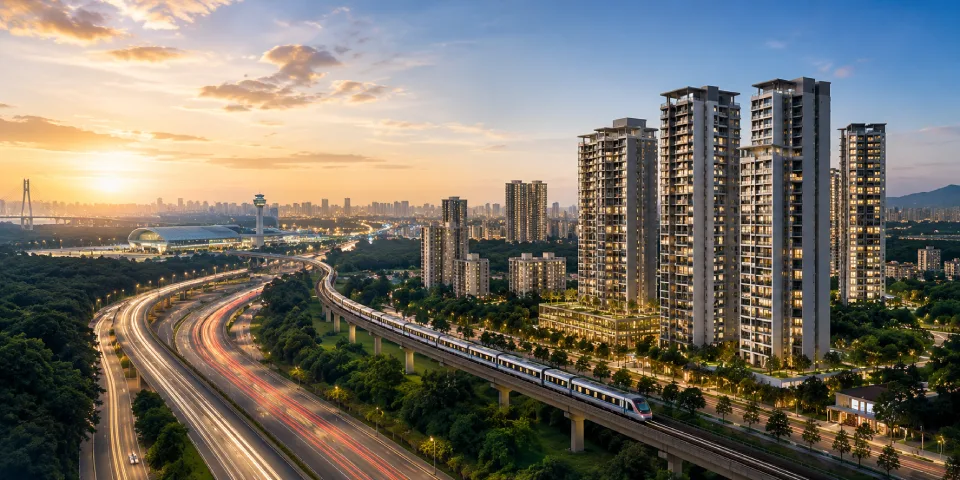
For decades, the safest property bet in Mumbai was simple: buy close to the city centre. Better connectivity, more jobs, established infrastructure the logic was straightforward. That logic still holds, but it’s no longer the whole story.
Mumbai is no longer growing around one central business district. It’s expanding outward, across multiple corridors, powered by new infrastructure and emerging commercial hubs. This shift is what people mean when they talk about Mumbai 3.0 property appreciation value that isn’t just about where demand already exists, but about where it’s headed. And nowhere is that shift more visible than in Panvel and the wider Navi Mumbai region, where developers like Anant Realty have spent over a decade building ahead of the curve.
A Different Set of Questions Buyers Are Asking
Buyers used to ask, “How popular is this area right now?” Increasingly, they’re asking something else:
- Will this location be better connected in five or ten years?
- Are new employment hubs coming up nearby?
- Is the infrastructure actually under construction, or just promised?
- Will the quality of life here improve over time?
These questions sit at the heart of Mumbai 3.0 property appreciation. Value is being shaped less by today’s demand and more by tomorrow’s development.
How Mumbai 3.0 Property Appreciation Actually Works
A common mistake buyers make is assuming prices jump the moment a big project gets announced. In reality, appreciation tends to unfold in stages.
Early on, prices stay relatively affordable because the infrastructure is still being built. As roads, metro lines, and commercial projects start taking real shape, buyer confidence grows, and demand followed by prices starts climbing. Once an area is genuinely functional, with schools, hospitals, offices, and retail all in place, the market usually settles into a more stable phase.
This gradual curve is exactly why Mumbai 3.0 property appreciation appeals to long-term buyers. Rather than chasing locations that have already peaked, many investors would rather get in where development is visible and the runway is still long.
Infrastructure: The Real Driver Behind Mumbai 3.0 Growth
A nice apartment or a flashy amenity list might help sell a unit, but long-term appreciation almost always comes down to one thing: how well-connected a place is, and how easy it is to actually live and work there. A few developments doing the heavy lifting right now:
Road Connectivity: New expressways and road corridors are cutting travel time between homes and workplaces, which alone makes emerging neighbourhoods far more attractive.
The Expanding Metro Network: As it grows across the Mumbai Metropolitan Region, it’s improving links between residential pockets and business districts, cutting commute times, and pushing up demand for homes near stations.
Airport and Commercial Development: The Navi Mumbai International Airport, along with the business parks and commercial projects springing up around it, is expected to bring in thousands of jobs. And where jobs go, housing demand tends to follow. This is a big part of why many experts see Mumbai 3.0 as a long-term investment story tied to infrastructure, not short-term sentiment.
Why Buyers Are Paying Attention to Mumbai 3.0
Today’s buyers aren’t just looking for a home, they’re looking for future value. Established areas offer stability, sure, but they also come with higher entry prices and less room for real appreciation. Emerging markets offer something different: a chance to be part of a location’s growth story from an earlier point.
That said, not every “up-and-coming” area will actually deliver. Smart buyers tend to look past the marketing and check:
- How far infrastructure has actually progressed on the ground
- What commercial development is planned nearby
- Connectivity to business districts
- Access to schools, hospitals, and everyday conveniences
- The developer’s track record
When these line up, Mumbai 3.0 property appreciation reflects genuine demand not speculation dressed up as opportunity. It’s this kind of alignment that Anant Realty has built its Panvel projects around from day one.
Navi Mumbai and Panvel's Role in the Mumbai 3.0 Growth Story
No discussion about Mumbai 3.0 is complete without recognising the growing importance of Navi Mumbai real estate and Panvel in particular.
Unlike many older parts of Mumbai, Navi Mumbai was developed as a planned city with organised sectors, wider roads, dedicated commercial zones, and room for future expansion. These advantages continue to attract both residential and commercial development.
Today, Navi Mumbai real estate is benefiting from several transformative projects, including:
- Navi Mumbai International Airport
- Metro expansion
- Improved suburban rail connectivity
- New road corridors
- Growing commercial and IT developments
As these projects become operational, Navi Mumbai real estate is expected to remain one of the strongest contributors to the Mumbai 3.0 growth story and Panvel, at the intersection of nearly all of them, is emerging as its clearest beneficiary.
Anant Realty's Role in Panvel's
Infrastructure creates the opportunity, but it’s the developers who commit to a region early and stay committed who actually shape how it grows. In Panvel, Anant Realty has been doing exactly that for more than a decade.
Founded in 2012, Anant Realty identified Panvel’s long-term potential well before “Mumbai 3.0” became a common phrase in real estate conversations. Over 13+ years, the developer has delivered 7+ residential projects and helped more than 1,000 families find homes in this corridor, a track record that matters in a market where timelines slip and promises often outpace delivery.
That local presence shows up directly in Anant Realty’s current developments in Wardoli, Panvel:
- Anant Serene Park: 2, 3.5 & 4.5 BHK residences with direct access to the Mumbai-Pune Expressway, the railway network, upcoming metro corridors, and the Navi Mumbai International Airport.
- Anant Serene Villas: premium twin villas set around landscaped grounds, with a clubhouse and resort-style amenities, offering low-density living within the same well-connected corridor.
Both projects sit inside the exact infrastructure network driving Mumbai 3.0 property appreciation not adjacent to it. For buyers evaluating Panvel, that combination of a proven developer and a project built directly on the growth corridor is often what separates a sound long-term investment from a speculative bet.
What Actually Moves the Needle in Mumbai 3.0 Property Appreciation
Not every part of Mumbai 3.0 will appreciate at the same rate. Before committing, it’s worth weighing:
- Infrastructure progress projects under active construction inspire far more confidence than ones still on paper
- Connectivity proximity to metro stations, highways, and business districts
- Employment hubs nearby commercial zones tend to pull in residents
- Developer credibility a strong delivery record lowers your risk considerably
- Social infrastructure schools, hospitals, and retail that make a place livable, not just investable
Is Mumbai 3.0 Property Appreciation Worth It?
Mumbai’s growth story is entering a new chapter spreading across multiple corridors instead of orbiting one centre. For buyers open to looking beyond the obvious hotspots, Mumbai 3.0 property appreciation offers a genuine long-term opportunity, built on infrastructure rather than hype.
With momentum building behind Navi Mumbai real estate and growing confidence in Mumbai 3.0 as a long-term investment, buyers who prioritise research and patience over speed are the ones best placed to benefit from this next phase of Mumbai’s growth. And for those looking to act on it in Panvel, Anant Realty’s decade-plus presence in the corridor, backed by Anant Serene Park and Anant Serene Villas, offers a way to invest in that story with a developer who has already proven it can deliver.