
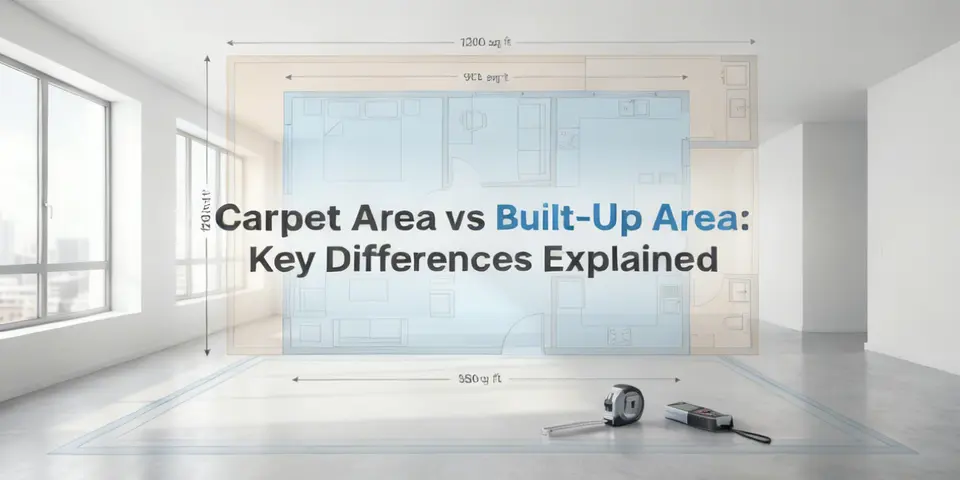
Most flat buyers in India spend months comparing locations, floors, and views but very few take ten minutes to understand what they are actually paying for on a per square foot basis. The difference between carpet area vs built-up area is not just a technical detail, it is the number that decides how much usable space you actually get for the price you pay.
Developers use different area measurements in their brochures, conversations, and agreements, and each one tells a different story. Understanding all three before you sign anything is the most practical thing a buyer can do for themselves.
What Carpet Area Actually Means
Carpet area is the only area measurement that represents space you can physically use inside your home every single day. It is legally defined under Section 2(k) of the RERA Act 2016 and it is now the only basis on which a developer is legally allowed to price a property in India. Everything else is either walls or shared space.
- The carpet area covers every room inside your flat; Bedrooms, Living Room, Kitchen, Bathrooms, and the Internal Partition Walls between them. It is literally the area where a CARPET can be laid.
- Balconies, Open Terraces, and Service Shafts are excluded from the carpet area definition under RERA. These are counted separately and cannot be included in the pricing calculation.
- Under RERA, if the final carpet area at possession differs from what was promised, the increase cannot exceed 3%. If it is less than promised, the developer must refund the difference with interest within 45 days.
What Built-Up Area Means and Where It Differs
Built-up vs carpet area is the first comparison buyers need to understand clearly. The built-up area adds one layer on top of the carpet area, the physical space occupied by the walls themselves, both internal and external, plus the balcony attached to your flat. None of this extra space is walk-around living space, but it is still private to you.
- Built-up area is typically 10 to 20% more than carpet area. A flat with 1,000 sq ft carpet area will have a built-up area of approximately 1,100 to 1,200 sq ft.
- The additional space in the built-up area is entirely accounted for by wall thickness and your private balcony. You cannot furnish or walk freely through this extra space if it exists structurally.
- Built-up area is mostly referenced in older resale properties and pre-RERA documentation. In new RERA-registered projects, pricing is always on carpet area only.
What is Super Built-Up Area? Why It Matters
Carpet Area vs Super Built-Up Area is where most buyers get genuinely confused and where the real money difference lies. Super built-up area, also called saleable area, takes your built-up area and adds your proportionate share of every common facility in the building lifts, lobbies, staircases, corridors, and sometimes even the clubhouse and gym.
- Carpet Area vs Super Built-Up Area gap is measured by the loading factor. Nationally, the average loading factor in Q1 2025 was 40% according to ANAROCK data. In Mumbai and MMR specifically, it reached 43%, the highest in India.
- A flat with 1,000 sq ft carpet area and a 40% loading factor will be marketed as a 1,400 sq ft super built-up area. You are paying for 400 sq ft of space that belongs to everyone in the building, not just you.
- The ideal loading factor for any project is 15 to 25%. Anything above 35% should prompt a direct question to the developer about exactly what is being counted in the common area calculation.
How to Calculate What You Are Actually Paying Per Usable Sq Ft
Once you know all three numbers, the calculation that actually matters is straightforward. Divide the total price of the flat by the carpet area, not the super built-up area. That gives you the real cost of every square foot you can live in.
Simple Calculation Example
Imagine a flat priced at ₹80 lakh.
If the carpet area is 700 sq ft, the real price per square foot is:
80,00,000 ÷ 700 = ₹11,428 per sq ft
But if someone mistakenly calculates the price using a 1,000 sq ft super built-up area, it appears as:
80,00,000 ÷ 1,000 = ₹8,000 per sq ft
At first glance, ₹8,000 per sq ft may seem cheaper, but the buyer is actually paying ₹11,428 for each square foot of usable living space.
This example shows why understanding carpet area vs super area is essential when evaluating property value.
Always ask the developer to confirm the carpet area in writing before booking. Under RERA, it must appear in the sale agreement. If a developer only provides super built-up area figures in the agreement, that is a compliance gap worth flagging.
Verify the registered carpet area directly on maharerait.mahaonline.gov.in using the project’s RERA registration number. All MahaRERA-registered projects in Maharashtra, including every current 1 BHK in Panvel project, have this information publicly accessible on the portal.
The Simple Checklist Before You Finalise Any Flat
Knowing the definitions is useful. Applying them before signing is what actually protects your money. These four questions take less than thirty minutes to answer and they give you a complete picture of what you are really buying.
- Ask for the carpet area number specifically as it appears in the RERA registration, not the marketing brochure. Calculate the loading factor yourself: super built-up area minus carpet area, divided by carpet area, multiplied by 100.
- Check the sale agreement carefully. Under RERA, the agreement must state carpet area as the pricing basis. If it only mentions super built-up or built-up areas, ask for a corrected version before paying any amount beyond the token.
- Compare across projects on carpet area per sq ft, not super built-up per sq ft. Two projects in the same area quoting similar rates per sq ft can have very different actual costs once you standardise on carpet area.
Understanding carpet area vs built-up area is not about catching developers out; most RERA-compliant projects today disclose these numbers correctly. It is about reading those disclosures yourself rather than relying on what a salesperson summarises for you over a phone call. The numbers are there. Take ten minutes to look at them before you commit.